MinuteRead
30 min
A friend once told John Allen Paulos that she was terrified of flying. She knew, intellectually, that commercial aviation was remarkably safe. She had read the statistics. Yet every time she boarded a plane, her palms grew damp and her heart raced. When Paulos asked her how she felt about driving to the airport, she shrugged. No anxiety at all.
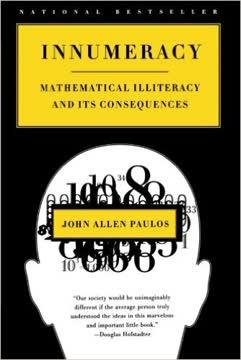
### Mathematical Illiteracy and Its Consequences
**Author:** John Allen Paulos
**Estimated Reading Time:** 85 minutes
**What You'll Learn:**
- Why otherwise intelligent people struggle with basic numerical concepts - How probability actually works and why coincidences are common - The hidden costs of mathematical illiteracy in daily life - Practical tools for developing better number sense - How to spot statistical manipulation and pseudoscience
**Who This Book Is For:**
Anyone who has ever said "I'm just not a math person." Anyone who reads news headlines with statistics and feels uncertain about what they mean. Anyone who wants to make better decisions about money, health, and risk. And anyone curious about why numbers matter more than most people realize.
A friend once told John Allen Paulos that she was terrified of flying. She knew, intellectually, that commercial aviation was remarkably safe. She had read the statistics. Yet every time she boarded a plane, her palms grew damp and her heart raced. When Paulos asked her how she felt about driving to the airport, she shrugged. No anxiety at all. The numbers tell a clear story. Driving is vastly more dangerous than flying. Per mile traveled, the risk of death in a car is many times higher than in an airplane. But this woman, like millions of otherwise intelligent people, could not translate statistical knowledge into emotional understanding. The numbers remained abstract, disconnected from her lived experience. She was, in Paulos's term, innumerate. Innumeracy is the mathematical counterpart to illiteracy. It is the inability to deal comfortably with the fundamental notions of number and chance. And it plagues far too many otherwise knowledgeable citizens. The problem is not confined to those who struggled in school. It affects college graduates, professionals, journalists, politicians, and even scientists in unrelated fields. People who would be embarrassed to admit they cannot read a simple sentence will proudly declare, "I'm just not a math person." They say it with a smile, as if confessing a charming quirk rather than a serious deficiency. This attitude would be puzzling if applied to any other fundamental skill. Imagine someone boasting about being unable to read a map, or proudly announcing they cannot follow a simple written argument. Yet when it comes to numbers, the confession is socially acceptable, even endearing. The cultural message is clear: mathematics is for specialists, and ordinary people need not concern themselves with it. Paulos wrote this book because he believes that message is dangerous. The consequences of innumeracy extend far beyond awkward moments at dinner parties. They shape how people manage their money, evaluate medical treatments, assess political claims, and understand the risks they face every day. An innumerate person is vulnerable to financial scams,…
Continue reading in the MinuteRead app
Get the complete 30-minute summary of Innumeracy
Get the complete summary in the appInnumeracy is the inability to deal comfortably with numbers and chance, and it has serious consequences for decision-ma
Unlikely events happen constantly because there are so many opportunities for them. Coincidences are not meaningful; the
Correlation does not imply causation. Two things can be correlated because of a third factor, reverse causation, or pure
Always consider the base rate. A test that is 99 percent accurate can produce many false positives when the condition is
A million and a billion are vastly different. A million seconds is 11.5 days. A billion seconds is 32 years.
Random events cluster and create apparent patterns. Do not mistake noise for signal.
"Innumeracy" is a strong fit if you want practical ideas around mathematics, science, psychology, especially themes like innumeracy is the inability to deal comfortably with numbers and chance, and it has serious consequences for decision-ma; unlikely events happen constantly because there are so many opportunities for them. coincidences are not meaningful; the. The MinuteRead summary distills these concepts into a focused read, whether you're deciding whether to buy the book or applying its lessons at work.
John Allen Paulos is an American professor of mathematics at Temple University, known for his work in mathematical literacy and humor. He gained prominence with the publication of Innumeracy: Mathematical Illiteracy and Its Consequences in 1988. Paulos has authored several other popular mathematics books, including "A Mathematician Reads the Newspaper" and "Beyond Numeracy." His writing style combines mathematical concepts with everyday examples and humor to make complex ideas accessible to a ge…
View all summaries by John Allen PaulosContinue Reading
Access the complete 30-minute summary and thousands more nonfiction books in the MinuteRead app.

Continue reading the complete summary in the MinuteRead app.