MinuteRead
30 min
Book summary
by Jeff Gothelf
Premium summary · Opens in the app · 30 min read
Every few years, a new methodology sweeps through the business world promising to solve the problems of the previous approach. Agile promised to fix the rigidity of waterfall development. Lean Startup promised to fix the waste of building things nobody wanted. Design Thinking promised to fix the blindness of building without understanding users. Each arrived with passionate advocates, compelling case studies, and a vocabulary that spread rapidly through organizations.
**Author:** Jeff Gothelf
**Estimated Reading Time:** 42 minutes
**What You'll Learn:**
- Why Agile, Lean Startup, and Design Thinking are not competing methodologies but complementary forces - How to integrate these approaches into a unified system for building better products - Why customer-centricity matters more than any process - How balanced teams outperform siloed disciplines - Practical ways to test high-risk assumptions without wasting resources - How to build a culture of continuous learning and experimentation
**Who This Book Is For:**
This book is for product managers, designers, engineers, and organizational leaders who feel caught between competing methodologies. If your engineering team is learning Agile while your product team studies Lean and your design team practices Design Thinking, you have likely experienced the friction that comes from misaligned approaches. This book helps you understand each philosophy deeply and shows you how to bring them together into a coherent, practical system.
Every few years, a new methodology sweeps through the business world promising to solve the problems of the previous approach. Agile promised to fix the rigidity of waterfall development. Lean Startup promised to fix the waste of building things nobody wanted. Design Thinking promised to fix the blindness of building without understanding users. Each arrived with passionate advocates, compelling case studies, and a vocabulary that spread rapidly through organizations. Then something predictable happened. Companies adopted these methodologies in isolation, assigning each to a different department. Engineering teams learned Agile ceremonies and sprint planning. Product teams studied Lean Startup principles and began talking about minimum viable products. Design teams embraced Design Thinking workshops and empathy maps. Each group developed its own language, its own rituals, and its own definition of success. The result was not harmony but confusion. Engineers wanted to ship code quickly. Product managers wanted to validate assumptions before committing resources. Designers wanted to conduct thorough research before defining solutions. Each perspective made sense in isolation, but together they created friction. Teams argued about priorities. Leaders struggled to understand why their investments in methodology training were not producing better outcomes. The organization became a collection of well-intentioned groups pulling in different directions. Jeff Gothelf wrote this book to address that exact problem. His central argument is simple but profound: Agile, Lean Startup, and Design Thinking are not competing philosophies. They are complementary approaches that address different aspects of the same challenge. Agile focuses on how teams work together to deliver software. Lean Startup focuses on what to build and whether it is worth building. Design Thinking focuses on who you are building for and what they truly need. When integrated properly, they form a complete system for creating products that are valuable, feasible, and usable. The problem is that…
Continue reading in the MinuteRead app
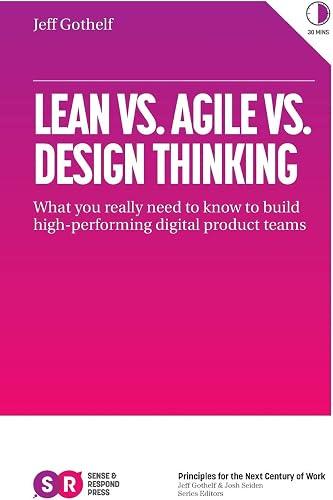
Get the complete 30-minute summary of Lean Vs. Agile Vs. Design Thinking
Get the complete summary in the app**Agile, Lean Startup, and Design Thinking are complementary, not competing.** Agile addresses how teams work. Lean Star
**Respond to change over following a plan.** Plans are based on assumptions. Assumptions often prove wrong. Adapt when t
**Ask "Should we build it?" not just "Can we build it?"** Technical feasibility is rarely the problem. Market demand is.
**Treat MVPs as experiments, not products.** The goal is learning, not shipping.
**Practice empathy continuously, not occasionally.** Design Thinking is a practice, not a workshop.
**Work in short cycles with regular retrospectives.** Fast feedback loops enable course correction. Retrospectives drive
"Lean Vs. Agile Vs. Design Thinking" is a strong fit if you want practical ideas around design, business, management, especially themes like **agile, lean startup, and design thinking are complementary, not competing.** agile addresses how teams work. lean star; **respond to change over following a plan.** plans are based on assumptions. assumptions often prove wrong. adapt when t. The MinuteRead summary distills these concepts into a focused read, whether you're deciding whether to buy the book or applying its lessons at work.
Motivated to turn hard-won expertise into something readers can use every day, Jeff Gothelf wrote “Lean Vs. Agile Vs. Design Thinking” to distill the ideas behind the work into clear, actionable lessons. Through “Lean Vs. Agile Vs. Design Thinking”, Jeff Gothelf distills the core ideas on design into lessons readers can absorb in a single short sitting. Readers turn to this work when they want Jeff Gothelf's perspective on the subject without working through the entire original volume. The book …
View all summaries by Jeff GothelfContinue Reading
Access the complete 30-minute summary and thousands more nonfiction books in the MinuteRead app.

Continue reading the complete summary in the MinuteRead app.