MinuteRead
30 min
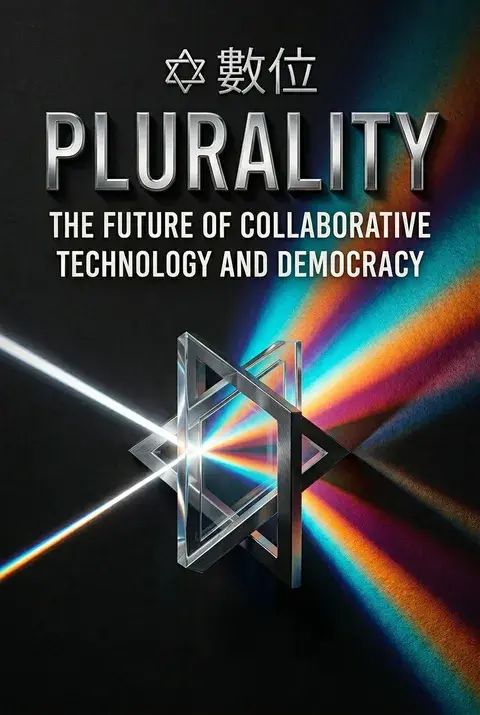
Book summary
by E. Glen Weyl
Premium summary · Opens in the app · 30 min read
Something strange has happened to the relationship between technology and democracy. For decades, the prevailing assumption was that the internet would naturally democratize information, empower ordinary people, and weaken the grip of centralized power. The early internet was suffused with utopian rhetoric about connection, openness, and liberation. Yet somewhere along the way, that promise curdled.
**Author:** E. Glen Weyl
**Estimated Reading Time:** 45 minutes
**What You'll Learn:**
- Why the dominant technological ideologies of our time are failing democracy - How Taiwan built a working model of digital democracy against enormous odds - What "plurality" means as a philosophy and as a practical design principle - How identity, association, property, and markets can be reimagined for a networked age - What post-symbolic communication and augmented deliberation offer for human connection - How to apply these ideas in your own community, workplace, and civic life
**Who This Book Is For:**
This book is for anyone who senses that something is deeply wrong with the relationship between technology and democracy. It is for people who feel trapped between the cold efficiency of centralized platforms and the chaotic fragmentation of unmoderated digital spaces. It is for citizens, technologists, policymakers, organizers, and curious minds who want to understand how we might build digital tools that bring people together across differences rather than driving them apart. If you have ever wondered whether technology could strengthen democracy instead of undermining it, this book offers a path forward grounded in real-world experiments and a coherent philosophical vision.
Something strange has happened to the relationship between technology and democracy. For decades, the prevailing assumption was that the internet would naturally democratize information, empower ordinary people, and weaken the grip of centralized power. The early internet was suffused with utopian rhetoric about connection, openness, and liberation. Yet somewhere along the way, that promise curdled. Today, artificial intelligence concentrates power in the hands of a few corporations that control the models shaping what we see, read, and believe. Blockchain technologies, despite their rhetoric of decentralization, have often accelerated financial speculation and atomized polarization rather than fostering genuine collective agency. Social media platforms, designed to connect people, have become engines of outrage, division, and manipulation. The result is a widening gulf between the technologies we use every day and the democratic values we claim to hold dear. This gulf is not accidental. It stems from a deeper philosophical failure. The dominant ideologies that have shaped digital technology share a common assumption: that the social world consists of isolated individuals on one hand and a monolithic whole on the other. Libertarians see only individuals making choices in a marketplace. Technocrats see only aggregates to be optimized by centralized systems. Both perspectives miss the rich fabric of human social life: the overlapping communities, the intersecting identities, the dense networks of affiliation that make us who we are. E. Glen Weyl calls this missing perspective "plurality." The term, represented by the Unicode character ⿻, captures the idea of collaboration across social difference. Plurality is not a compromise between individualism…
Continue reading in the MinuteRead app
Get the complete 30-minute summary of ⿻ 數位 Plurality
Get the complete summary in the appPlurality is technology for collaboration across social difference.
The dominant technological ideologies of our time are built on a flawed understanding of human sociality.
Taiwan shows that digital democracy is possible in practice, not just in theory.
Digital rights should be understood as an operating system that defines the possibility space for action.
Contextual integrity is more important than pure privacy.
Identity is social and relational, not individual and atomic.
"⿻ 數位 Plurality" is a strong fit if you want practical ideas around politics, technology, philosophy, especially themes like plurality is technology for collaboration across social difference; the dominant technological ideologies of our time are built on a flawed understanding of human sociality. The MinuteRead summary distills these concepts into a focused read, whether you're deciding whether to buy the book or applying its lessons at work.
Motivated to help readers with plurality captures the symbiotic relationship between democracy and collaborative technology, E. Glen Weyl wrote “⿻ 數位 Plurality” to package those ideas for a fast, focused read. In “⿻ 數位 Plurality”, E. Glen Weyl focuses on plurality captures the symbiotic relationship between democracy and collaborative technology. Through “⿻ 數位 Plurality”, E. Glen Weyl distills the core ideas on politics into lessons readers can absorb in a single short sitting. Readers turn to t…
Continue Reading
Access the complete 30-minute summary and thousands more nonfiction books in the MinuteRead app.

Continue reading the complete summary in the MinuteRead app.