MinuteRead
30 min
Book summary
by Becky Bond
Premium summary · Opens in the app · 30 min read
Every campaign begins with a moment of impossible ambition. Someone looks at the way things are and decides they cannot stand. They look at the gap between what is and what should be and they say: we are going to close that gap. Then they look at their resources. A few staff members. A modest budget. A list of supporters that feels far too small. And the question becomes: how do we get from here to millions?
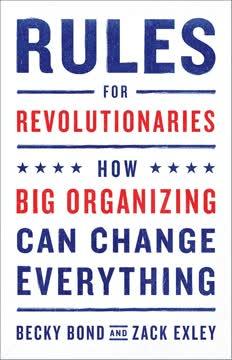
**Author:** Becky Bond and Zack Exley
**Estimated Reading Time:** 45 minutes
**What You'll Learn:** How to build massive, volunteer-powered movements that can challenge entrenched power. You will learn the principles of big organizing, the art of empowering volunteers as leaders, the role of technology in scaling participation, and the discipline required to stay focused when opposition arrives.
**Who This Book Is For:** Organizers, activists, campaign staffers, nonprofit leaders, and anyone who believes that real change requires mobilizing millions of people, not just collecting donations or signing online petitions.
Every campaign begins with a moment of impossible ambition. Someone looks at the way things are and decides they cannot stand. They look at the gap between what is and what should be and they say: we are going to close that gap. Then they look at their resources. A few staff members. A modest budget. A list of supporters that feels far too small. And the question becomes: how do we get from here to millions? This book exists because the old answers to that question no longer work. For decades, political campaigns and advocacy organizations operated on a simple premise. Professionals run the show. Volunteers stuff envelopes, knock on doors when told, and donate money. The experts make the decisions. The supporters execute. This model produced modest results. It also produced a profound sense of disconnection. Millions of people wanted to do more than click a button or give five dollars. They wanted to lead. They wanted to build. They wanted to be part of something that actually changed the world. The problem is not a lack of passion. The problem is a lack of structure. Most campaigns do not know how to absorb the energy of the people who show up. They treat volunteers as a resource to be managed rather than as leaders to be developed. They hoard responsibility. They centralize decision-making. They build bottlenecks where there should be pipelines. Becky Bond and Zack Exley learned a different way during Bernie Sanders' 2016 presidential campaign. They were part of a small team given an impossible task: build a volunteer operation that could compete with the most well-funded political machine in modern American history. They had no money to hire thousands of staffers. They had no time to build traditional field offices. They had no choice but to try something radical. What they discovered changed how they think about organizing forever. The campaign gave volunteers real power. It asked them to run phone banks, host events, manage teams, and make decisions that would normally be reserved for paid staff. It used consumer technology like Slack, Google Docs, and text messaging to coordinate tens of thousands of people across the…
Continue reading in the MinuteRead app
Get the complete 30-minute summary of Rules for Revolutionaries
Get the complete summary in the app**Scale matters.** Build campaigns designed to mobilize millions, not thousands.
**Volunteers are leaders, not helpers.** Give them real responsibility and real power.
**The revolution will not be staffed.** You cannot hire your way to victory.
**Anti-racism must be at the core.** A movement not led by people of color is not a revolution.
**Use consumer software.** Build on tools people already know how to use.
**Create rinse and repeat processes.** Simplicity enables scale.
"Rules for Revolutionaries" is a strong fit if you want practical ideas around politics, activism, social justice, especially themes like **scale matters.** build campaigns designed to mobilize millions, not thousands; **volunteers are leaders, not helpers.** give them real responsibility and real power. The MinuteRead summary distills these concepts into a focused read, whether you're deciding whether to buy the book or applying its lessons at work.
Becky Bond and Zack Exley are political organizers and strategists who worked on Bernie Sanders' 2016 presidential campaign. Becky Bond and Zack Exley draw from their experience to provide insights into grassroots organizing and political campaigning in their book "Rules for Revolutionaries." Bond has a background in progressive activism and has worked with various organizations, including CREDO Mobile. Exley has been involved in multiple political campaigns and has experience in digital organiz…
View all summaries by Becky BondContinue Reading
Access the complete 30-minute summary and thousands more nonfiction books in the MinuteRead app.

Continue reading the complete summary in the MinuteRead app.