MinuteRead
30 min
Book summary
Premium summary · Opens in the app · 30 min read
Every day you make hundreds of design decisions without thinking about them. You arrange chairs before guests arrive. You choose which route to drive to work. You decide what to wear based on the weather, the occasion, and your mood. You select one brand of coffee over another, often for reasons you could not fully articulate. None of this feels like design. It feels like living.
**Author:** Henry Petroski
**Estimated Reading Time:** 42 minutes
**What You'll Learn:**
- Why the ordinary objects around you carry extraordinary design stories - How constraints, compromises, and choices shape everything humans create - Why perfection is an illusion and improvement is the real goal - How to see the designed world with new eyes and sharper judgment
**Who This Book Is For:**
Anyone who has ever struggled with a stubborn package, admired a well-made tool, wondered why a chair feels wrong, or felt frustrated by a product that almost works. If you use things, you are already a design critic. This book will help you become a better one.
Every day you make hundreds of design decisions without thinking about them. You arrange chairs before guests arrive. You choose which route to drive to work. You decide what to wear based on the weather, the occasion, and your mood. You select one brand of coffee over another, often for reasons you could not fully articulate. None of this feels like design. It feels like living. But Henry Petroski, one of the most thoughtful engineers and writers of the past half century, argues that these ordinary choices reveal something profound. Design is not the exclusive territory of architects sketching skylines or engineers calculating load tolerances. Design is a fundamental human activity, woven so deeply into daily life that we barely notice it. We think, therefore we design. The problem is that most of us move through the designed world half asleep. We accept the objects around us as given, as if they simply appeared fully formed. We rarely pause to ask why a drinking glass has the shape it does, why a paper cup evolved the way it did, or why the Brita water pitcher in your refrigerator looks different from the one your parents owned. When something works, we ignore it. When something fails, we curse it. But we seldom ask the deeper question: what was the designer thinking? This book exists to wake you up. Petroski's approach is different from most design writing. He does not offer a grand theory or a rigid methodology. He does not promise to turn you into a professional designer. Instead, he invites you to look closely at the small things you encounter every day: the cup holder in your car, the faucet in your sink, the packaging around your food, the headlights on the road ahead. Each of these objects, he shows, is a solution to a problem. Each carries within it a history of choices, constraints, compromises, and improvements. Each is a record of human ingenuity and human limitation. The reason people struggle to understand design is that good design often becomes…
Continue reading in the MinuteRead app
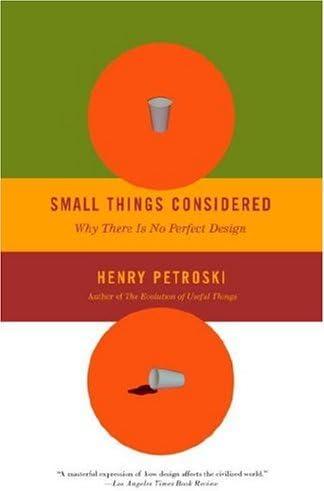
Get the complete 30-minute summary of Small Things Considered
Get the complete summary in the appDesign is everywhere. You are already a designer, whether you know it or not.
Constraints are not obstacles. They are the foundation of design.
Every choice has costs, including hidden costs that are easy to overlook.
Compromise is inevitable. Accept it and focus on finding the best possible balance.
Perfection is an illusion. Strive for improvement, not perfection.
Context matters. What works in one situation may fail in another.
"Small Things Considered" is a strong fit if you want practical ideas around design, science, technology, especially themes like design is everywhere. you are already a designer, whether you know it or not; constraints are not obstacles. they are the foundation of design. The MinuteRead summary distills these concepts into a focused read, whether you're deciding whether to buy the book or applying its lessons at work.
Motivated to help readers with because so much of what we do involves design of one kind or another, Henry Petroski wrote “Small Things Considered” to package those ideas for a fast, focused read. In “Small Things Considered”, Henry Petroski focuses on because so much of what we do involves design of one kind or another. Through “Small Things Considered”, Henry Petroski distills the core ideas on design into lessons readers can absorb in a single short sitting. Readers turn to this work when the…
View all summaries by Henry PetroskiContinue Reading
Access the complete 30-minute summary and thousands more nonfiction books in the MinuteRead app.

Continue reading the complete summary in the MinuteRead app.