MinuteRead
30 min
Book summary
by David Borman
Premium summary · Opens in the app · 30 min read
Every day, numbers are used to persuade you. A news report claims that a certain food reduces the risk of heart disease by 30 percent. A political poll says a candidate is leading by four points. A company announces that its new product outperforms the competition. A medical study suggests a drug is effective. These claims all share a common foundation: statistics.
**Author:** David Borman
**Estimated Reading Time:** 45 minutes
**What You'll Learn**
This condensed edition teaches you how statistics actually works, not just as a collection of formulas but as a way of thinking. You will learn how data is collected and why collection matters more than calculation. You will understand the difference between describing data and making inferences from it. You will discover how probability quantifies uncertainty, how hypothesis testing validates claims, and how regression analysis reveals relationships hidden inside numbers. You will also learn how to spot misleading statistics and how to apply ethical judgment when presenting data.
**Who This Book Is For**
This book is for anyone who encounters statistics in daily life and wants to understand what the numbers actually mean. It is for professionals who need to interpret reports, students who want a clear foundation, and curious readers who suspect that statistics is more useful and more interesting than they were taught. No advanced mathematics is required. What matters is your willingness to think clearly about evidence.
Every day, numbers are used to persuade you. A news report claims that a certain food reduces the risk of heart disease by 30 percent. A political poll says a candidate is leading by four points. A company announces that its new product outperforms the competition. A medical study suggests a drug is effective. These claims all share a common foundation: statistics. Most people respond to such claims in one of two ways. Some accept the numbers without question, assuming that if a study produced them, they must be true. Others dismiss statistics entirely, believing that numbers can be manipulated to prove anything. Both responses are mistakes. The first gives too much credit to numbers without examining how they were produced. The second gives up on a powerful tool simply because it can be misused. Statistics is not magic, and it is not deception by default. Statistics is the discipline of measuring data and interpreting that data to prove or disprove a point. It is a systematic way of collecting information, analyzing it, and drawing conclusions that are more reliable than intuition or anecdote. When used properly, statistics helps us see patterns that would otherwise remain invisible. It helps us make decisions under uncertainty. It helps us distinguish between real effects and random noise. The problem is that most people never learn how statistics actually works. They may have taken a class in school, but the class likely focused on formulas and procedures rather than understanding. They learned how to calculate a mean but not why the mean can mislead. They learned how to draw a graph but not how graphs can distort. They learned how to run a…
Continue reading in the MinuteRead app
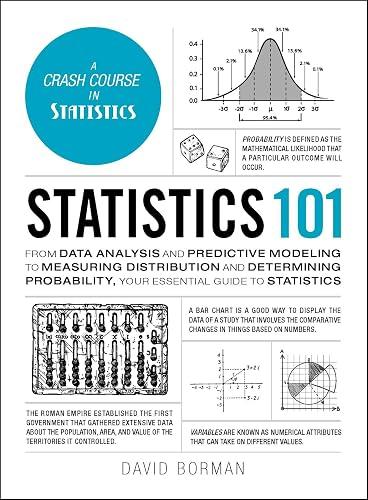
Get the complete 30-minute summary of Statistics 101
Get the complete summary in the appStatistics is the discipline of collecting, analyzing, and interpreting data to answer questions and make decisions.
Garbage in, garbage out. The quality of the analysis depends on the quality of the data.
A large biased sample is still biased. Sample size does not compensate for poor sampling.
The mean is sensitive to outliers. Consider the median for skewed data.
Probability quantifies uncertainty. Always consider base rates.
A p-value is the probability of the data given the null hypothesis, not the probability that the null hypothesis is true
"Statistics 101" is a strong fit if you want practical ideas around mathematics, science, reference, especially themes like statistics is the discipline of collecting, analyzing, and interpreting data to answer questions and make decisions; garbage in, garbage out. the quality of the analysis depends on the quality of the data. The MinuteRead summary distills these concepts into a focused read, whether you're deciding whether to buy the book or applying its lessons at work.
Motivated to help readers with statistics is the measuring of data and interpreting that data to prove or disprove a point, David Borman wrote “Statistics 101” to package those ideas for a fast, focused read. In “Statistics 101”, David Borman focuses on statistics is the measuring of data and interpreting that data to prove or disprove a point. Through “Statistics 101”, David Borman distills the core ideas on mathematics into lessons readers can absorb in a single short sitting. Readers turn to …
Continue Reading
Access the complete 30-minute summary and thousands more nonfiction books in the MinuteRead app.

Continue reading the complete summary in the MinuteRead app.