MinuteRead
30 min
Book summary
by Torrey Podmajersky
Premium summary · Opens in the app · 30 min read
Every word in a digital product is a decision. Someone chose that button label, that error message, that empty state description. And every one of those decisions either moves the experience forward or creates friction. The difference between a product that feels intuitive and one that feels confusing often comes down to the quality of its words.
**Author:** Torrey Podmajersky **Estimated Reading Time:** 42 minutes
**What You'll Learn:** How to create UX content that serves both business goals and user needs, develop a consistent voice, apply proven text patterns, edit with precision, measure impact, and establish a strategic content practice.
**Who This Book Is For:** UX writers, content designers, product designers, product managers, and anyone responsible for the words people encounter in digital experiences.
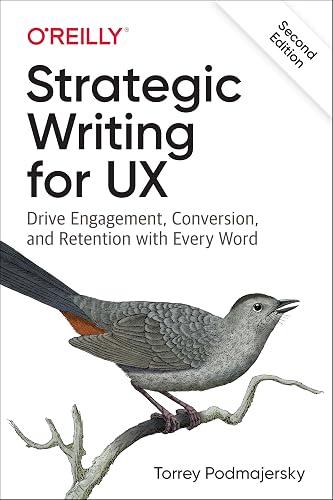
Every word in a digital product is a decision. Someone chose that button label, that error message, that empty state description. And every one of those decisions either moves the experience forward or creates friction. The difference between a product that feels intuitive and one that feels confusing often comes down to the quality of its words. Yet for years, the words in digital products were treated as an afterthought. Designers would create interfaces with placeholder text, expecting someone else to fill in the blanks later. Engineers would ship products with error messages they wrote themselves at the last minute. Product managers would focus on features and functionality while the actual language users encountered remained inconsistent, unclear, or simply broken. Torrey Podmajersky wrote Strategic Writing for UX to address a fundamental gap in how digital products are built. The book emerged from her years of experience writing for companies like Google, Microsoft, and OfferUp, where she saw firsthand how thoughtful UX content could transform user experiences and business outcomes. She also saw how the absence of strategic content thinking led to confused users, abandoned signups, and support tickets that could have been prevented with better words. The problem is not that people do not care about UX writing. The problem is that most people do not know how to think about it strategically. They treat individual pieces of text as isolated tasks rather than as parts of a coherent system. They write button labels without considering the user's emotional state. They create error messages without thinking about what the user needs to do next. They develop content guidelines without connecting them to business goals. Podmajersky's approach is different because she treats UX writing as a strategic discipline rather than a tactical one. She argues that every piece of text in an experience should serve two sets of goals simultaneously: the goals of the organization that built the product and the goals of the person using it. When these goals align, the result is a virtuous cycle where users succeed, the business grows, and the experience improves for everyone. What makes this book valuable is its practicality. Podmajersky does not just explain why UX writing matters. She provides concrete tools: voice charts that define how a product should sound, text patterns that provide starting…
Continue reading in the MinuteRead app
Get the complete 30-minute summary of Strategic Writing for UX
Get the complete summary in the appUX content serves two sets of goals simultaneously: user goals and organizational goals.
The virtuous cycle connects user success to business success through content.
Create a voice chart to define and maintain consistent voice across all content.
Use conversation design to understand the natural flow of user interactions before designing interfaces.
Apply UX text patterns as starting points for common interface elements.
Edit in four phases: purposeful, concise, conversational, clear.
"Strategic Writing for UX" is a strong fit if you want practical ideas around design, business, writing, especially themes like ux content serves two sets of goals simultaneously: user goals and organizational goals; the virtuous cycle connects user success to business success through content. The MinuteRead summary distills these concepts into a focused read, whether you're deciding whether to buy the book or applying its lessons at work.
Motivated to help readers with the strategic purpose of UX content is to meet two sets of goals: the goals of the organization responsible, Torrey Podmajersky wrote “Strategic Writing for UX” to package those ideas for a fast, focused read. In “Strategic Writing for UX”, Torrey Podmajersky focuses on the strategic purpose of UX content is to meet two sets of goals: the goals of the organization responsible. Through “Strategic Writing for UX”, Torrey Podmajersky distills the core ideas on design …
Continue Reading
Access the complete 30-minute summary and thousands more nonfiction books in the MinuteRead app.

Continue reading the complete summary in the MinuteRead app.