MinuteRead
30 min
Book summary
Premium summary · Opens in the app · 30 min read
In the mid-1990s, Richard Sennett encountered a man he calls Rico. Rico was the son of Enrico, a janitor whom Sennett had interviewed twenty-five years earlier for a study of working-class life in Boston. Enrico had spent twenty years cleaning toilets and mopping floors in an office building, saving money methodically, and watching his son rise into the professional class. Enrico's life had a clear arc. His work was not glamorous, but it was predictable. He knew when he would work, what he would
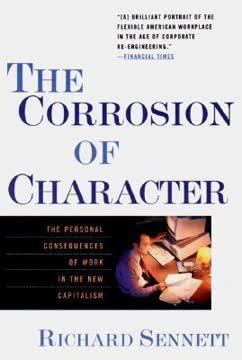
**Author:** Richard Sennett
**Estimated Reading Time:** 45 minutes
**What You'll Learn:**
- Why the modern economy makes it harder to build a coherent sense of self - How flexibility became the dominant value in workplaces and what it costs - Why routine work, once despised, now offers unexpected stability - How risk-taking shapes identity in ways both necessary and damaging - What happens when work values collide with personal values - Why community has become both a refuge and a limitation
**Who This Book Is For:**
Anyone who has ever felt that their work life and their inner life are pulling in opposite directions. Anyone who has wondered why it feels harder to build lasting relationships, stable identities, or meaningful commitments in an economy that demands constant change. This book is for workers, managers, parents, and citizens who sense that something important is being lost in the rush toward flexibility, and who want to understand what that loss means.
In the mid-1990s, Richard Sennett encountered a man he calls Rico. Rico was the son of Enrico, a janitor whom Sennett had interviewed twenty-five years earlier for a study of working-class life in Boston. Enrico had spent twenty years cleaning toilets and mopping floors in an office building, saving money methodically, and watching his son rise into the professional class. Enrico's life had a clear arc. His work was not glamorous, but it was predictable. He knew when he would work, what he would earn, and when he could retire. That predictability allowed him to plan, to save, and to build a stable family life. Rico, by contrast, had achieved everything his father wanted for him. He had a graduate degree, a successful career in technology consulting, and a comfortable income. Yet when Sennett met him, Rico was troubled. He had moved four times in fourteen years. His wife worked in a different city. His children were being raised partly by nannies and partly by the logistics of air travel. Rico described himself as successful but unanchored. He worried that his children would never know the stability he had taken for granted as a child. He worried that his own character was becoming thin, scattered, and reactive. This encounter frames the central question of The Corrosion of Character. What happens to human beings when the economy no longer rewards long-term thinking, loyalty, or commitment? What happens to our sense of self when work demands constant flexibility, constant reinvention, constant movement? Sennett's answer is both sobering and profound. The new capitalism, he argues, is corroding the very qualities that make stable character possible: trust, loyalty, commitment, and the ability to tell a coherent story about one's life. The problem is not simply…
Continue reading in the MinuteRead app
Get the complete 30-minute summary of The Corrosion of Character
Get the complete summary in the appCharacter requires time. The virtues of loyalty, trust, and commitment cannot develop without stable conditions.
The new capitalism values flexibility over stability, and this corrodes character.
Routine has been undervalued. It provides structure, enables mastery, and allows for planning.
Flexibility can be a form of control, not liberation.
Constant risk-taking creates insecurity and undermines the ability to plan.
Failure is a normal experience in the new economy, and coping with it requires narrative understanding.
"The Corrosion of Character" is a strong fit if you want practical ideas around sociology, economics, philosophy, especially themes like character requires time. the virtues of loyalty, trust, and commitment cannot develop without stable conditions; the new capitalism values flexibility over stability, and this corrodes character. The MinuteRead summary distills these concepts into a focused read, whether you're deciding whether to buy the book or applying its lessons at work.
Richard Sennett is a sociologist and writer who explores how individuals and groups interpret their social and cultural experiences, particularly in relation to cities and labor. His work combines ethnography, history, and social theory, following the pragmatist tradition. Sennett has written extensively on urban life, class identity, and the changing nature of work in modern capitalism. His books include "The Uses of Disorder," "The Fall of Public Man," and a series examining the personal conse…
View all summaries by Richard SennettContinue Reading
Access the complete 30-minute summary and thousands more nonfiction books in the MinuteRead app.

Continue reading the complete summary in the MinuteRead app.