MinuteRead
30 min
Book summary
Premium summary · Opens in the app · 30 min read
Every product that is used by someone creates a user experience. This is not a statement about websites or mobile apps. It is a statement about everything. Books create a user experience. Ketchup bottles create a user experience. Reclining armchairs and cardigan sweaters create user experiences. The moment a person interacts with an object, a system, a service, or another person, an experience unfolds.
**Author:** Jesse James Garrett
**Estimated Reading Time:** 45 minutes
**What You'll Learn:**
- Why user experience applies to every product you will ever create or use - The five planes framework that turns abstract strategy into concrete design - How to align business goals with genuine user needs - Why feature creep destroys products and how to prevent it - Practical methods for designing intuitive interfaces and information structures - How to balance convention with innovation without confusing users
**Who This Book Is For:**
This book is for designers, developers, product managers, entrepreneurs, and anyone who has ever wondered why some products feel effortless while others feel like a constant struggle. If you build things that people use, this book will change how you think about the process.
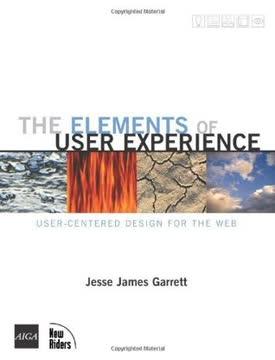
Every product that is used by someone creates a user experience. This is not a statement about websites or mobile apps. It is a statement about everything. Books create a user experience. Ketchup bottles create a user experience. Reclining armchairs and cardigan sweaters create user experiences. The moment a person interacts with an object, a system, a service, or another person, an experience unfolds. The problem is that most products are not designed with this experience in mind. They are designed around technology, around business requirements, around what the engineers can build, around what the marketing team wants to say. The experience that results is accidental. Sometimes it works. Often it does not. Think about the last time you struggled with a product. Maybe it was a website that made it impossible to find basic information. Maybe it was a software application that required you to memorize obscure commands. Maybe it was a door that looked like it should be pushed but actually needed to be pulled. In each case, the product failed you. But the deeper failure was not in the product itself. It was in the design process that created it. The people who built that product were not stupid. They were not careless. They simply lacked a framework for thinking about user experience in a systematic way. They made decisions in isolation, without understanding how those decisions would ripple outward and affect the person actually using the product. This book exists to provide that framework. Jesse James Garrett, a pioneer in the field of user experience design and co-founder of the consulting firm Adaptive Path, developed a model that has become foundational to how modern digital products are conceived and built. His diagram, known simply as "The Elements of User Experience," provides a conceptual structure for understanding the layers of decisions that go into creating a product. The insight at the heart of Garrett's work is that user experience…
Continue reading in the MinuteRead app
Get the complete 30-minute summary of The Elements of User Experience
Get the complete summary in the appEvery product creates a user experience, whether you design it deliberately or not.
The five planes of user experience are strategy, scope, structure, skeleton, and surface.
Start with strategy: What do we want? What do users want?
Avoid featuritis. A focused product beats a bloated one.
Design from the user's perspective, not the organization's.
Structure determines whether users can accomplish their goals.
"The Elements of User Experience" is a strong fit if you want practical ideas around design, business, website design, especially themes like every product creates a user experience, whether you design it deliberately or not; the five planes of user experience are strategy, scope, structure, skeleton, and surface. The MinuteRead summary distills these concepts into a focused read, whether you're deciding whether to buy the book or applying its lessons at work.
Jesse James Garrett is a prominent figure in the field of User Experience Design, based in San Francisco. He co-founded the consulting firm Adaptive Path and gained widespread recognition for his diagram "The Elements of User Experience," which later became a book. Garrett's influence extends beyond this work; he notably coined the term "Ajax" in 2005 to describe asynchronous web technologies that enabled seamless browsing experiences. His contributions have significantly shaped modern web desig…
View all summaries by Jesse James GarrettContinue Reading
Access the complete 30-minute summary and thousands more nonfiction books in the MinuteRead app.

Continue reading the complete summary in the MinuteRead app.