MinuteRead
30 min
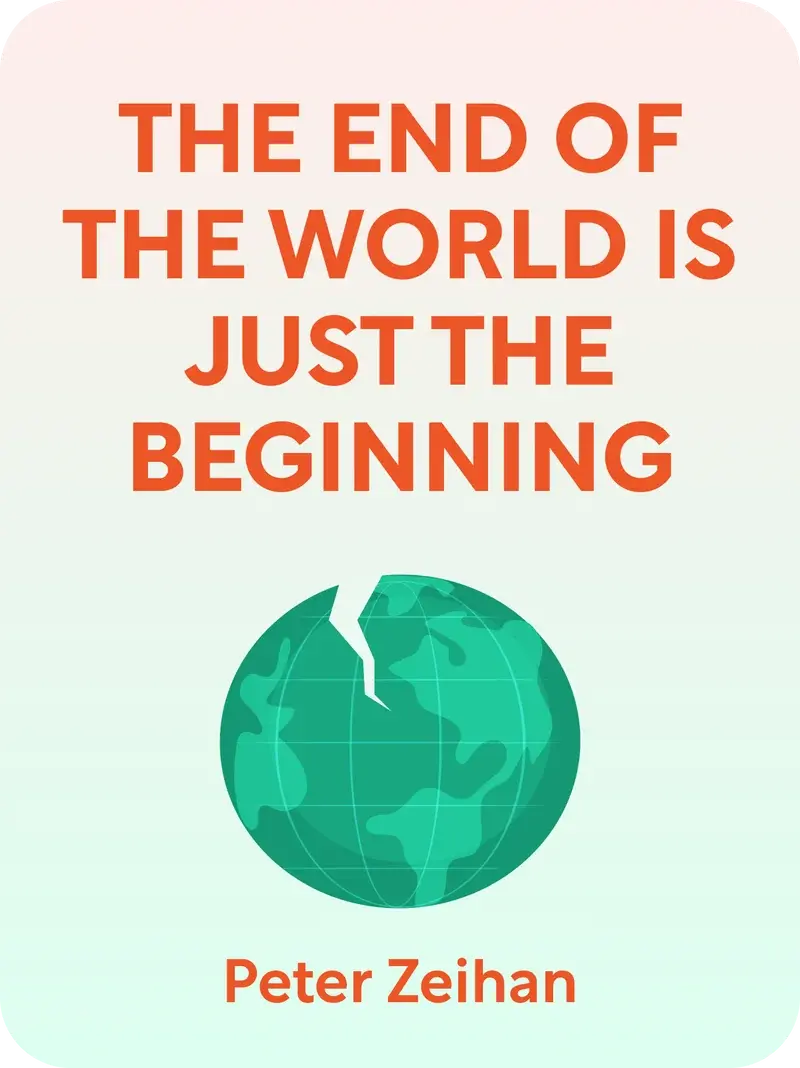
Book summary
by Peter Zeihan
Premium summary · Opens in the app · 30 min read
For seventy-five years, the world operated under a set of rules that most people never noticed. Goods moved freely across oceans. Money flowed across borders without friction. Wars between major powers became unthinkable. Energy remained cheap and abundant. The global economy grew at a pace unprecedented in human history.
**Author:** Peter Zeihan
**Estimated Reading Time:** 45 minutes
**What You'll Learn:** Why the global order that shaped your life is collapsing, which countries will thrive and which will fail, and how to position yourself for the turbulent decades ahead.
**Who This Book Is For:** Anyone who wants to understand the real forces driving inflation, supply chain chaos, war, and political instability. If you have wondered why the world suddenly feels broken, this book explains the structural reasons behind the breakdown.
For seventy-five years, the world operated under a set of rules that most people never noticed. Goods moved freely across oceans. Money flowed across borders without friction. Wars between major powers became unthinkable. Energy remained cheap and abundant. The global economy grew at a pace unprecedented in human history. That era is over. The system that made all of this possible was not natural. It was not inevitable. It was built and maintained by the United States after World War II, when American leaders made a calculated decision: rather than retreat into isolation as they had after World War I, they would build a global order. The U.S. Navy would patrol the world's oceans, guaranteeing safe passage for any ship flying any flag. The U.S. dollar would serve as the world's reserve currency, providing a stable foundation for international finance. American markets would remain open to imports, giving other countries a chance to rebuild and grow. In exchange, the United States received something less tangible but equally valuable: a world organized around American interests, American values, and American security. The Soviet Union was contained. Germany and Japan became stable democracies. Global trade expanded, lifting hundreds of millions out of poverty. This arrangement was expensive. The United States spent trillions of dollars maintaining military bases around the world, patrolling sea lanes, and underwriting international institutions. But American leaders understood something that critics of the system often missed: the cost of maintaining order was far lower than the cost of fighting wars in a disordered world. Now that calculation has changed. The United States is withdrawing from its role as global guarantor. The reasons are complex: demographic decline among America's allies, the rise of China, domestic political pressures, and a growing recognition that the old system no longer serves American interests as clearly as it once did. Whatever the causes, the consequences are becoming visible everywhere. Shipping costs have spiked. Supply chains that once stretched across the globe are snapping. Countries that depended on imported food, energy, and manufactured goods are discovering how vulnerable they have become. Regional powers are testing their strength. Wars that would have been unthinkable a generation ago are now underway. Peter Zeihan argues that this is not…
Continue reading in the MinuteRead app
Get the complete 30-minute summary of The End of the World Is Just the Beginning
Get the complete summary in the appThe American-led global order is breaking down. The world is entering a new era of deglobalization, regional blocs, and
Demographics are destiny. Countries with shrinking populations cannot maintain their economic or military power.
Geography is destiny. Countries with abundant resources and defensible borders will thrive. Countries without these adva
The American security umbrella made globalization possible. As it is withdrawn, global trade will fragment.
The era of cheap energy is ending. Energy security will become a critical concern for most countries.
The dollar's status as the world's reserve currency is eroding. Regional currency blocs may emerge.
"The End of the World Is Just the Beginning" is a strong fit if you want practical ideas around politics, history, economics, especially themes like the american-led global order is breaking down. the world is entering a new era of deglobalization, regional blocs, and; demographics are destiny. countries with shrinking populations cannot maintain their economic or military power. The MinuteRead summary distills these concepts into a focused read, whether you're deciding whether to buy the book or applying its lessons at work.
Peter Zeihan is a geopolitical strategist and author known for his expertise in global energy, demographics, and security. With a background in the US State Department and private intelligence, Zeihan founded his own firm in 2012. He provides custom analysis to clients across various sectors, including energy, finance, and the military. Zeihan's work combines geography, population trends, and global politics to forecast economic and geopolitical developments. His accessible writing style and irr…
View all summaries by Peter ZeihanContinue Reading
Access the complete 30-minute summary and thousands more nonfiction books in the MinuteRead app.

Continue reading the complete summary in the MinuteRead app.