MinuteRead
30 min
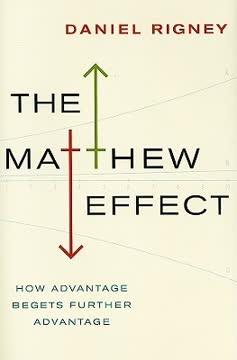
Book summary
Premium summary · Opens in the app · 30 min read
In the Gospel of Matthew, Jesus tells a parable about a master who entrusts his servants with talents before departing on a journey. To one servant he gives five talents, to another two, and to a third one. The first two servants invest their talents and double their money. The third buries his talent in the ground, afraid of losing it. When the master returns, he rewards the first two servants and punishes the third, taking away even the single talent he had been given and giving it to the serv
**Author:** Daniel Rigney
**Estimated Reading Time:** 45 minutes
**What You'll Learn:**
- Why advantages tend to accumulate and compound over time - How the Matthew Effect operates in science, economics, politics, and education - Why early advantages often create widening gaps that persist across generations - What forces can counteract cumulative advantage - How to recognize and respond to these dynamics in your own life and society
**Who This Book Is For:**
This book is for anyone who has ever wondered why the rich seem to get richer, why famous scientists receive credit for work they barely contributed to, why some children thrive in school while others fall further behind, and why power concentrates so predictably in the hands of a few. It is for readers who want to understand the hidden mechanisms that shape inequality, and for those who believe that understanding these mechanisms is the first step toward building a fairer world.
In the Gospel of Matthew, Jesus tells a parable about a master who entrusts his servants with talents before departing on a journey. To one servant he gives five talents, to another two, and to a third one. The first two servants invest their talents and double their money. The third buries his talent in the ground, afraid of losing it. When the master returns, he rewards the first two servants and punishes the third, taking away even the single talent he had been given and giving it to the servant who now has ten. The parable concludes with a statement that has echoed through centuries: "For whosoever hath, to him shall be given, and he shall have more abundance: but whosoever hath not, from him shall be taken away even that he hath." This verse, with its stark depiction of advantage multiplying and disadvantage compounding, gives its name to one of the most powerful ideas in modern sociology. The Matthew Effect, as sociologist Robert K. Merton termed it in 1968, describes a pattern that appears across nearly every domain of human life: initial advantages tend to accumulate, creating widening gaps between those who have more and those who have less. The rich get richer. The famous get more famous. The skilled get more opportunities to develop their skills. The connected get more connections. Daniel Rigney's book explores this phenomenon in depth, examining how it operates in science, economics, politics, education, and culture. But this is not merely an academic exercise. Understanding the Matthew Effect is essential for anyone who wants to understand why inequality persists, why talent sometimes goes unrecognized, and why well-intentioned efforts to level the playing field so often fall short. The problem the Matthew Effect illuminates is both ancient and urgent. Every…
Continue reading in the MinuteRead app
Get the complete 30-minute summary of The Matthew Effect
Get the complete summary in the appThe Matthew Effect describes how advantage accumulates: those who have more tend to gain more, while those who have less
The mechanism is a positive feedback loop: initial advantage produces more advantage, which produces still more advantag
In science, famous researchers receive disproportionate credit for collaborative work, regardless of who actually did th
In economics, wealth compounds through interest and investment returns, widening the gap between rich and poor.
In politics, incumbency advantage and campaign finance concentrate power in the hands of a few.
In education, early reading skills compound over time, producing widening achievement gaps.
"The Matthew Effect" is a strong fit if you want practical ideas around sociology, economics, especially themes like the matthew effect describes how advantage accumulates: those who have more tend to gain more, while those who have less; the mechanism is a positive feedback loop: initial advantage produces more advantage, which produces still more advantag. The MinuteRead summary distills these concepts into a focused read, whether you're deciding whether to buy the book or applying its lessons at work.
Daniel Rigney is the author of "The Matthew effect," a book that explores the sociological concept of cumulative advantage. While specific details about Rigney's background are not provided in the given information, his work demonstrates expertise in sociology and an interest in examining inequality across various sectors of society. Rigney's writing style is described as accessible by some readers, suggesting his ability to communicate complex ideas to a general audience. His political leanings…
View all summaries by Daniel RigneyContinue Reading
Access the complete 30-minute summary and thousands more nonfiction books in the MinuteRead app.

Continue reading the complete summary in the MinuteRead app.