MinuteRead
30 min
Every few centuries, the fundamental unit of human political organization changes. Tribes gave way to city-states. City-states consolidated into empires. Empires fractured into nation-states. Each transition was driven by a technological revolution that changed how people communicated, coordinated, and exercised power. The printing press helped create nationalism. The railroad and telegraph enabled continental-scale governance. The nuclear bomb froze borders in place.
**Author:** Balaji S. Srinivasan **Estimated Reading Time:** 45 minutes
**What You'll Learn:**
- Why the nation-state may not be the final form of human political organization - How technology enables entirely new ways of building societies - The step-by-step process for founding a network state - Why moral innovation matters more than geographic territory - How cryptocurrency and blockchain create new forms of sovereignty
**Who This Book Is For:**
This book is for anyone who senses that the current political system is failing but cannot articulate what might replace it. It is for entrepreneurs, technologists, and builders who want to understand how digital tools might reshape governance. It is for people who feel politically homeless, who believe that existing institutions are too slow, too corrupt, or too disconnected from the communities they claim to serve. If you have ever wondered whether we can build something better than what we inherited, this book offers a blueprint.
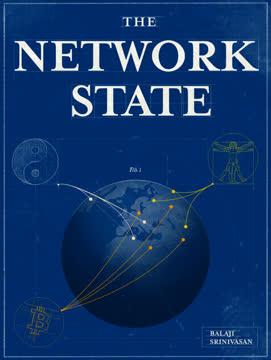
Every few centuries, the fundamental unit of human political organization changes. Tribes gave way to city-states. City-states consolidated into empires. Empires fractured into nation-states. Each transition was driven by a technological revolution that changed how people communicated, coordinated, and exercised power. The printing press helped create nationalism. The railroad and telegraph enabled continental-scale governance. The nuclear bomb froze borders in place. We are now living through another such transition. The internet has collapsed the cost of communication to nearly zero. Cryptocurrency has created money that no state controls. Blockchain technology has produced records that no institution can alter. These tools are not merely conveniences. They are the raw materials for a new form of political organization. The nation-state, for all its historical success, is showing signs of strain. Governments struggle to solve problems that cross borders. Citizens feel increasingly disconnected from the institutions that claim to represent them. Political discourse has become a battlefield of manufactured narratives. Trust in centralized authority continues to decline. Meanwhile, online communities have become more meaningful to many people than their physical neighborhoods. People now form deep bonds with others thousands of miles away, united by shared values rather than shared geography. Balaji Srinivasan saw this transformation happening and asked a simple question: what comes next? If the nation-state is not the end of history, what replaces it? His answer is the network state, a new form of political entity that starts online and gradually acquires physical presence. It is a social network with a moral innovation, a sense of national consciousness, a recognized founder, a capacity for collective action, an in-person level of civility, an integrated cryptocurrency, a consensual government limited by a social smart contract, an archipelago of crowdfunded physical territories, a virtual capital, and an on-chain census…
Continue reading in the MinuteRead app
Get the complete 30-minute summary of The Network State
Get the complete summary in the appA network state starts as an online community with a moral innovation and grows into a political entity with physical te
The path is gradual: startup society, network union, network archipelago, network state.
The on-chain census provides verifiable proof of existence through population, income, and real estate footprint data.
The integrated cryptocurrency provides economic sovereignty and enables cross-border economic activity.
The social smart contract is a governance framework encoded in software, consensual and limited by design.
The virtual capital is the digital center of the network state, equally accessible to all members.
"The Network State" is a strong fit if you want practical ideas around politics, philosophy, technology, especially themes like a network state starts as an online community with a moral innovation and grows into a political entity with physical te; the path is gradual: startup society, network union, network archipelago, network state. The MinuteRead summary distills these concepts into a focused read, whether you're deciding whether to buy the book or applying its lessons at work.
Balaji S. Srinivasan is a prominent entrepreneur and investor in the tech industry. He has held leadership positions at major companies like Coinbase and Andreessen Horowitz. Srinivasan has invested in numerous successful tech startups and cryptocurrency projects, demonstrating his expertise in emerging technologies. He co-founded several companies, including Earn.com and Counsyl, which were later acquired. His academic background includes multiple degrees in engineering from Stanford University…
View all summaries by Balaji S. SrinivasanContinue Reading
Access the complete 30-minute summary and thousands more nonfiction books in the MinuteRead app.

Continue reading the complete summary in the MinuteRead app.