MinuteRead
30 min
Book summary
Premium summary · Opens in the app · 30 min read
Most Americans believe they live in a free country protected by the rule of law. They assume the Constitution stands between them and arbitrary government power. They trust that prosecutors seek justice, that trials determine guilt, and that innocent people have nothing to fear.
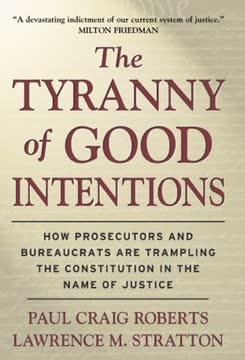
**Author:** Paul Craig Roberts **Estimated Reading Time:** 2 hours, 15 minutes
### What You'll Learn
How centuries-old legal protections that once shielded ordinary people from government power have been systematically dismantled in America. You will understand why the presumption of innocence, the right to trial, and protection from arbitrary punishment have eroded, and what this means for anyone who believes they will never be targeted by the justice system.
### Who This Book Is For
Anyone who assumes the legal system will protect them. Anyone who believes only guilty people get convicted. Anyone who has watched a news story about a prosecution and thought, "That could never happen to me." This book is a wake-up call about how good intentions, expanded government power, and unchecked prosecutorial ambition have created a system where innocence offers surprisingly little protection.
Most Americans believe they live in a free country protected by the rule of law. They assume the Constitution stands between them and arbitrary government power. They trust that prosecutors seek justice, that trials determine guilt, and that innocent people have nothing to fear. Paul Craig Roberts argues that this confidence is dangerously misplaced. The book traces a quiet revolution in American law. Over decades, legal principles that once protected individuals from state power have been weakened, reinterpreted, or simply ignored. The result is a system where prosecutors wield enormous leverage, where criminal intent no longer matters for many offenses, where property can be seized without conviction, and where the right to trial has been replaced by a plea bargaining machine that processes defendants with industrial efficiency. Roberts grounds his argument in history. The legal protections Americans once enjoyed did not appear by accident. They emerged from centuries of English legal tradition, hard-won battles against monarchical power, and deliberate choices by the Founding Fathers to embed specific safeguards in the Constitution. These protections, known collectively as the Rights of Englishmen, included the presumption of innocence, protection against self-incrimination, the right to a speedy trial, prohibition of cruel and unusual punishment, and protection against unreasonable searches and seizures. These were not abstract ideals. They were practical barriers between the individual and the state. They recognized a fundamental truth: government power, however well-intentioned, tends to expand. Without strong legal protections, that power will eventually consume the liberties it was meant to protect. Roberts identifies a philosophical shift that made this erosion possible. The utilitarian philosophy of Jeremy Bentham, which prioritizes the "greatest good for the greatest number," gradually displaced the rights-based thinking of the Founders. Under Benthamite logic, individual rights become negotiable. If convicting an innocent person serves some larger social purpose, the utilitarian calculus permits it. If seizing property without trial helps fund law…
Continue reading in the MinuteRead app
Get the complete 30-minute summary of The Tyranny of Good Intentions
Get the complete summary in the appThe legal protections Americans once enjoyed emerged from centuries of English legal tradition and were embedded in the
These protections have been systematically weakened through gradual reinterpretation, not dramatic repeal. Each erosion
The philosophical engine driving this erosion is utilitarianism, which treats individual rights as negotiable factors ra
The requirement of criminal intent has been eliminated for thousands of offenses. You can be convicted and imprisoned fo
Plea bargaining has replaced trials as the mechanism for resolving criminal cases. The pressure to plead guilty is so in
Asset forfeiture allows the government to seize property without criminal conviction. The burden falls on the owner to p
"The Tyranny of Good Intentions" is a strong fit if you want practical ideas around politics, law, history, especially themes like the legal protections americans once enjoyed emerged from centuries of english legal tradition and were embedded in the; these protections have been systematically weakened through gradual reinterpretation, not dramatic repeal. each erosion. The MinuteRead summary distills these concepts into a focused read, whether you're deciding whether to buy the book or applying its lessons at work.
Paul Craig Roberts is an economist, journalist, and former government official. He served as the United States Assistant Secretary of the Treasury for Economic Policy under President Ronald Reagan. Roberts has authored numerous books on economics, politics, and social issues. He is known for his critical views on U.S. foreign and domestic policies. Roberts has written extensively on topics such as globalization, the erosion of civil liberties, and the American justice system. His work often chal…
View all summaries by Paul Craig RobertsContinue Reading
Access the complete 30-minute summary and thousands more nonfiction books in the MinuteRead app.

Continue reading the complete summary in the MinuteRead app.