MinuteRead
30 min
Book summary
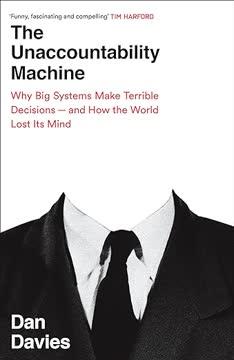
by Dan Davies
Premium summary · Opens in the app · 30 min read
There is a particular kind of frustration that defines modern life. You call a company to resolve a problem. The automated system routes you through menus. The representative who eventually answers cannot actually help you. They can only follow a script. When you ask to speak to someone with authority, you discover that no such person exists, or at least no such person is reachable. The company has made a decision that affects your life, but no human being appears to have made that decision. No
**Author:** Dan Davies **Estimated Reading Time:** 42 minutes
**What You'll Learn:** Why modern institutions seem incapable of taking responsibility, how systems designed to manage complexity have instead created new forms of dysfunction, and what cybernetics can teach us about building organizations that actually work.
**Who This Book Is For:** Anyone who has ever been trapped in an automated customer service loop, frustrated by a corporation that seems designed to avoid responsibility, or puzzled by the gap between what organizations say they do and what they actually do.
There is a particular kind of frustration that defines modern life. You call a company to resolve a problem. The automated system routes you through menus. The representative who eventually answers cannot actually help you. They can only follow a script. When you ask to speak to someone with authority, you discover that no such person exists, or at least no such person is reachable. The company has made a decision that affects your life, but no human being appears to have made that decision. No one is accountable. This experience is not limited to customer service. It happens when a bank's algorithm denies your loan application. It happens when a government agency loses your paperwork across three departments. It happens when a social media platform's content moderation system removes your post and no appeal process can reach a human being with actual judgment. It happens when a hospital's scheduling software creates a dangerous gap in care and every individual involved was simply following procedure. Dan Davies calls this phenomenon the "accountability sink." It is a structure that absorbs responsibility without attributing it to any specific person. And it is, he argues, one of the defining features of contemporary institutional life. The strange thing is that these systems were not designed by malicious people. They emerged from genuine attempts to solve real problems. Organizations became too complex for any single person to understand. Decision-making had to be distributed. Procedures had to be standardized. Information had to be filtered. The result was supposed to be greater efficiency, consistency, and fairness. Instead, we got something else. We got organizations that can act without thinking, that can cause harm without anyone being responsible, that can persist in obviously dysfunctional behavior because no one inside them has the authority or incentive to change course. Davies approaches this problem from an unusual angle. Rather than simply condemning bureaucracy or calling for more regulation, he draws on a largely forgotten intellectual tradition: cybernetics. This field, developed in the mid-twentieth century by figures like Norbert Wiener and Stafford Beer, studied how systems maintain control through feedback. It asked fundamental questions about how information flows through organizations, how decisions get made,…
Continue reading in the MinuteRead app
Get the complete 30-minute summary of The Unaccountability Machine
Get the complete summary in the appThe purpose of a system is what it does, not what it says it does.
Accountability sinks absorb responsibility without attributing it to anyone.
Control requires feedback. Broken feedback loops cause dysfunction.
Organizations need internal variety to match the variety of their environment.
Economics has blind spots that have shaped organizational design in harmful ways.
The Friedman Doctrine created perverse incentives that prioritize short-term profit over long-term sustainability.
"The Unaccountability Machine" is a strong fit if you want practical ideas around politics, business, economics, especially themes like the purpose of a system is what it does, not what it says it does; accountability sinks absorb responsibility without attributing it to anyone. The MinuteRead summary distills these concepts into a focused read, whether you're deciding whether to buy the book or applying its lessons at work.
Dan Davies is a writer and management consultant known for his engaging and thought-provoking work. His book explores the intersection of cybernetics, management theory, and accountability in modern organizations. Davies draws on his expertise in finance and economics to analyze complex systems and their unintended consequences. He demonstrates a keen interest in how organizational structures impact decision-making and responsibility. Davies' writing style is described as fun and accessible, mak…
View all summaries by Dan DaviesContinue Reading
Access the complete 30-minute summary and thousands more nonfiction books in the MinuteRead app.

Continue reading the complete summary in the MinuteRead app.