MinuteRead
30 min
Book summary
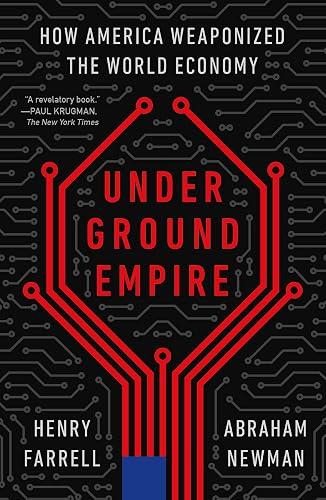
by Henry Farrell
Premium summary · Opens in the app · 30 min read
In the decades after the Cold War, a remarkable story took hold. The story said that the world was flattening, that borders were becoming less relevant, that commerce and technology would knit humanity together into a single prosperous community. Companies would operate freely across continents. Information would flow without constraint. Money would move at the speed of light. Governments, with their slow bureaucracies and territorial obsessions, would gradually recede from relevance.
**Author:** Henry Farrell **Estimated Reading Time:** 45 minutes
**What You'll Learn:**
How the mundane infrastructure of globalization, fiber-optic cables, payment systems, semiconductor supply chains, became the foundation of a new form of American power. You will understand how this hidden empire operates, why it emerged without conscious design, and what it means for businesses, nations, and the future of global order.
**Who This Book Is For:**
Anyone trying to understand why the world feels increasingly fragmented despite decades of deepening interconnection. Business leaders navigating geopolitical risk, policymakers grappling with economic security, and curious readers who sense that something fundamental has shifted in how power works across borders will find this book essential.
In the decades after the Cold War, a remarkable story took hold. The story said that the world was flattening, that borders were becoming less relevant, that commerce and technology would knit humanity together into a single prosperous community. Companies would operate freely across continents. Information would flow without constraint. Money would move at the speed of light. Governments, with their slow bureaucracies and territorial obsessions, would gradually recede from relevance. This story was never entirely true, but for a while it felt true enough. The infrastructure of globalization grew rapidly and invisibly. Cables were laid beneath oceans. Server farms rose in quiet industrial parks. Payment systems were built to clear transactions between banks that had never met. Supply chains stretched across the Pacific and back again. All of this happened with remarkably little public attention or political oversight. Then came the shocks. The September 11 attacks revealed that terrorists had used the same open networks to coordinate their plot. The 2008 financial crisis showed how deeply interconnected the world's banks had become. The Snowden revelations exposed the scale of government surveillance running through the internet's backbone. The Trump administration's aggressive use of sanctions against Iran demonstrated that American financial power could reach into any boardroom on earth. Russia's invasion of Ukraine triggered an unprecedented weaponization of economic infrastructure, from SWIFT exclusion to central bank asset freezes. And the campaign against Huawei showed that control over semiconductor design software could cripple a company that threatened American technological dominance. Each of these events was treated as a separate crisis. But Henry Farrell argues that they are all manifestations of a single underlying transformation. Without anyone quite intending it, the United States has built an underground empire. Its territory is not marked on any map. Its borders are defined by the reach of dollar clearing, the jurisdiction of American courts over data stored on American servers, and the control points where global networks converge. Its power is exercised not through armies marching across frontiers but through quiet decisions made in…
Continue reading in the MinuteRead app
Get the complete 30-minute summary of Underground Empire
Get the complete summary in the appThe infrastructure of globalization is not neutral. It can be controlled, and the United States controls the most import
The dollar clearing system is the central choke point of global finance. Any institution that needs dollar clearing is s
The internet's physical infrastructure is concentrated in ways that enable unprecedented surveillance. American control
The foreign-produced direct product rule extends American export controls beyond American borders. Control over semicond
The underground empire was not designed. It emerged from uncoordinated decisions by private companies and government age
Networks tend to centralize. Control the choke points, and you control the network.
"Underground Empire" is a strong fit if you want practical ideas around politics, economics, history, especially themes like the infrastructure of globalization is not neutral. it can be controlled, and the united states controls the most import; the dollar clearing system is the central choke point of global finance. any institution that needs dollar clearing is s. The MinuteRead summary distills these concepts into a focused read, whether you're deciding whether to buy the book or applying its lessons at work.
Motivated to help readers with modern empire has turned the subterranean machineries that enable global markets and information, Henry Farrell wrote “Underground Empire” to package those ideas for a fast, focused read. In “Underground Empire”, Henry Farrell focuses on modern empire has turned the subterranean machineries that enable global markets and information. Through “Underground Empire”, Henry Farrell distills the core ideas on politics into lessons readers can absorb in a single short sit…
Continue Reading
Access the complete 30-minute summary and thousands more nonfiction books in the MinuteRead app.

Continue reading the complete summary in the MinuteRead app.