MinuteRead
30 min
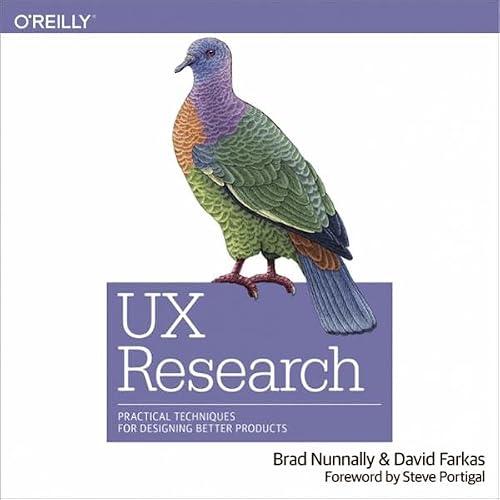
Book summary
by Brad Nunnally
Premium summary · Opens in the app · 30 min read
Every product you have ever used, every app on your phone, every website you have visited, every physical object you have touched, was designed by someone who made decisions about how it should work. Some of those decisions were informed by careful study of how people actually behave. Most were not.
**Author:** Brad Nunnally **Estimated Reading Time:** 45 minutes
The complete discipline of user experience research, from crafting unbiased questions and recruiting the right participants to analyzing data and communicating findings that actually drive product decisions. You will learn the difference between quantitative and qualitative methods, how to facilitate research sessions with confidence, and how to turn raw observations into insights that shape better products.
Product managers who need to make evidence-based decisions. Designers who want to ground their work in real user needs rather than assumptions. Startup founders who cannot afford to build the wrong thing. Researchers who want a practical framework for their craft. And anyone who has ever wondered why some products feel intuitive while others feel broken.
Every product you have ever used, every app on your phone, every website you have visited, every physical object you have touched, was designed by someone who made decisions about how it should work. Some of those decisions were informed by careful study of how people actually behave. Most were not. The result is a world filled with products that frustrate, confuse, and fail. Doors that look like they should be pushed but must be pulled. Software that hides the most important feature behind three layers of menus. Forms that ask for information in an order that makes no sense to the person filling them out. These failures are not random. They are the predictable consequence of designing without research. Brad Nunnally wrote UX Research to address a simple but persistent problem: teams build products based on assumptions, opinions, and guesses, then wonder why users do not respond the way they expected. The book makes a compelling case that research is not an optional luxury or a box to check. It is the foundation upon which all successful product development rests. The challenge is that research has a reputation problem. Many people hear the word and imagine sterile laboratories, clipboards, and statistical jargon. Others think of it as slow, expensive, and disconnected from the fast pace of modern product development. Some believe they already know their users well enough. Others simply do not know where to begin. Nunnally dismantles these misconceptions one by one. He shows that research is not a barrier to speed but a safeguard against waste. It is not about asking people what they want but about understanding what they need, what they do, and why they struggle. It is not an academic exercise but a practical tool for making better decisions faster. The book traces the history of research in product development back to the industrial revolution, when pioneers like Frank Gilbreth studied the motions of bricklayers to eliminate wasted effort. Gilbreth did not ask bricklayers…
Continue reading in the MinuteRead app
Get the complete 30-minute summary of UX Research
Get the complete summary in the appResearch is the foundation of user-centered design. You cannot design effectively for people you do not understand.
The quality of your research is determined by the quality of your questions. Ask open-ended, neutral questions that focu
Quantitative and qualitative methods are complements, not competitors. Use both to gain a complete picture.
Recruit the right participants. Research with the wrong people produces misleading findings.
Active listening is the foundation of effective facilitation. Give participants your full attention and respond to what
Allocate at least three hours of analysis for every hour of research. Analysis is where the value is created.
"UX Research" is a strong fit if you want practical ideas around design, business, technology, especially themes like research is the foundation of user-centered design. you cannot design effectively for people you do not understand; the quality of your research is determined by the quality of your questions. ask open-ended, neutral questions that focu. The MinuteRead summary distills these concepts into a focused read, whether you're deciding whether to buy the book or applying its lessons at work.
Motivated to help readers with if we knew what it was we were doing, Brad Nunnally wrote “UX Research” to package those ideas for a fast, focused read. In “UX Research”, Brad Nunnally focuses on if we knew what it was we were doing. Through “UX Research”, Brad Nunnally distills the core ideas on design into lessons readers can absorb in a single short sitting. Readers turn to this work when they want Brad Nunnally's perspective on the subject without working through the entire original volume. B…
Continue Reading
Access the complete 30-minute summary and thousands more nonfiction books in the MinuteRead app.

Continue reading the complete summary in the MinuteRead app.