MinuteRead
30 min
Book summary
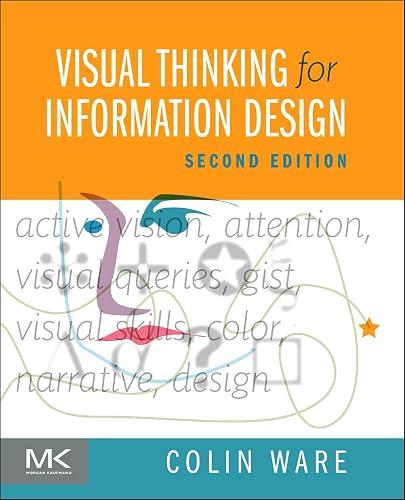
by Colin Ware
Premium summary · Opens in the app · 30 min read
Look around the room you are sitting in right now. Notice the objects on your desk, the quality of light through the window, the colors and textures of the walls. It feels as though you are seeing everything at once, a complete and detailed picture of your environment, captured effortlessly by your eyes and delivered to your conscious mind.
**Author:** Colin Ware
**Estimated Reading Time:** 45 minutes
**What You'll Learn:** How the human brain constructs visual experience, why some designs feel effortless while others create confusion, and how to apply the science of perception to think more clearly, communicate more effectively, and design better visual tools.
**Who This Book Is For:** Designers, data analysts, educators, managers, and anyone who wants to understand why visual communication works or fails, and how to harness the remarkable capabilities of human vision.
Look around the room you are sitting in right now. Notice the objects on your desk, the quality of light through the window, the colors and textures of the walls. It feels as though you are seeing everything at once, a complete and detailed picture of your environment, captured effortlessly by your eyes and delivered to your conscious mind. This feeling is an illusion. At any given instant, you actually see very little. The part of your retina capable of high-resolution vision is roughly the size of your thumbnail held at arm's length. Everything outside that tiny region is blurry, low-resolution, and lacking in color detail. Yet you do not experience the world this way. You experience a rich, stable, fully detailed visual environment. The reason is that your brain is not a camera passively recording whatever light happens to enter your eyes. It is an active, searching, questioning system that constructs your visual experience by rapidly sampling the environment through constant eye movements. Your eyes dart around three or four times every second, gathering small pieces of high-quality information, and your brain stitches these pieces together into the seamless experience you call seeing. This insight lies at the heart of Colin Ware's work. For decades, Ware has stood at the intersection of neuroscience, psychology, and computer graphics, asking a deceptively simple question: How does the human brain actually process visual information, and what does that mean for how we should design the tools, displays, and representations we use every day? The answer matters more than most people realize. We live in an increasingly visual world. Screens dominate our work and leisure. Data visualizations shape decisions in business, science, and government. Diagrams and charts are the common language of meetings and reports. Yet most of us have never learned how visual perception actually works. We design presentations, dashboards, and documents based on intuition, habit, and software defaults rather than on an understanding of the brain that will ultimately interpret them. The result is a world full of confusing interfaces, misleading charts, and visual clutter that forces our brains to work harder than necessary. We blame ourselves when we struggle to understand a complex diagram or fail to spot the key trend…
Continue reading in the MinuteRead app
Get the complete 30-minute summary of Visual Thinking
Get the complete summary in the appVisual perception is active, not passive. The brain constructs visual experience through rapid eye movements and selecti
Visual working memory can hold only about three objects or patterns at a time. Design displays that respect this limit.
Visual thinking is a dance between mind and world. External representations are part of the thinking process, not just e
Effective design starts with understanding the queries users need to perform, not with the data you want to present.
Luminance contrast is essential for fine detail and text legibility. Color contrast alone is insufficient.
Use redundant encodings to ensure accessibility. Color should not be the only way to distinguish important information.
"Visual Thinking" is a strong fit if you want practical ideas around design, psychology, science, especially themes like visual perception is active, not passive. the brain constructs visual experience through rapid eye movements and selecti; visual working memory can hold only about three objects or patterns at a time. design displays that respect this limit. The MinuteRead summary distills these concepts into a focused read, whether you're deciding whether to buy the book or applying its lessons at work.
Motivated to help readers with we see very little at any given instant, Colin Ware wrote “Visual Thinking” to package those ideas for a fast, focused read. In “Visual Thinking”, Colin Ware focuses on we see very little at any given instant. Through “Visual Thinking”, Colin Ware distills the core ideas on design into lessons readers can absorb in a single short sitting. Readers turn to this work when they want Colin Ware's perspective on the subject without working through the entire original vol…
Continue Reading
Access the complete 30-minute summary and thousands more nonfiction books in the MinuteRead app.

Continue reading the complete summary in the MinuteRead app.