MinuteRead
30 min
Book summary
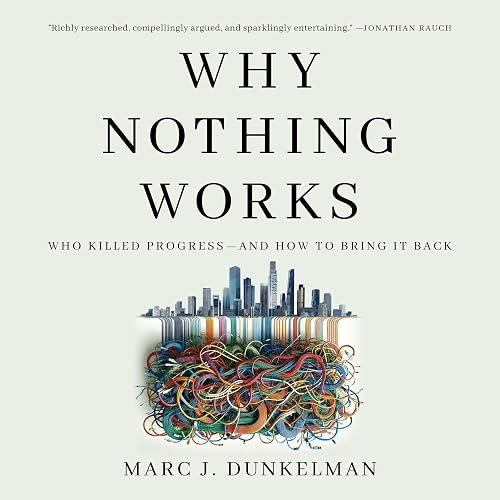
by Marc J. Dunkelman
Premium summary · Opens in the app · 30 min read
There is a peculiar frustration that defines modern American life. We live in a country that once built the interstate highway system in a generation, electrified an entire region through the Tennessee Valley Authority, and put a man on the moon. Yet today, a single transmission line for renewable energy can take fifteen years to permit. A modest apartment building in a coastal city can face a decade of lawsuits before ground is broken. A high-speed rail project can consume billions of dollars b
**Author:** Marc J. Dunkelman
**Estimated Reading Time:** 45 minutes
**What You'll Learn:** Why a political movement dedicated to using government to solve problems has inadvertently made government incapable of solving anything. You'll discover the hidden ideological conflict at the heart of American progressivism, how well-intentioned reforms became instruments of paralysis, and what it would take to restore the government's ability to act.
**Who This Book Is For:** Anyone frustrated by the gap between what government promises and what it delivers. Whether you care about housing, infrastructure, clean energy, or simply want to understand why modern America struggles to build things, this book explains the deeper forces at work.
There is a peculiar frustration that defines modern American life. We live in a country that once built the interstate highway system in a generation, electrified an entire region through the Tennessee Valley Authority, and put a man on the moon. Yet today, a single transmission line for renewable energy can take fifteen years to permit. A modest apartment building in a coastal city can face a decade of lawsuits before ground is broken. A high-speed rail project can consume billions of dollars before a single mile of track is laid. Something has gone wrong. The question is what. The standard explanations are familiar. Polarization has made compromise impossible. Money in politics has corrupted the process. NIMBYism has blocked necessary development. Regulatory capture has turned agencies into servants of the industries they were meant to oversee. Each of these explanations contains a kernel of truth. But none of them fully explains the phenomenon. They describe symptoms, not the underlying disease. Marc J. Dunkelman offers a different diagnosis. The problem, he argues, is not simply that government has been captured or corrupted or gridlocked by partisan warfare. The problem is that progressivism itself, the political tradition most committed to using government as an instrument of public good, has been internally torn between two contradictory impulses for more than a century. One impulse seeks to build up public power to solve collective problems. The other seeks to tear down public power to protect individual liberty. The tension between these impulses has always existed. But in recent decades, the balance has shifted dramatically toward the latter, with consequences that progressives themselves have failed to recognize. The result is a movement that claims to want an active, capable government but has spent decades creating tools that make active, capable government impossible. It is a movement that says it wants to build, but has armed itself primarily with tools of obstruction. It is a movement that fears concentrated power so deeply that it has rendered itself incapable of exercising power at all. This book traces how that…
Continue reading in the MinuteRead app
Get the complete 30-minute summary of Why Nothing Works
Get the complete summary in the appProgressivism has always contained two competing impulses: Hamiltonian (build public power) and Jeffersonian (constrain
The mid-twentieth century was the high point of Hamiltonian progressivism, when the Establishment built the institutions
The 1960s marked a shift from fear of chaos to fear of tyranny, driven by Vietnam, civil rights, and environmental conce
The reforms of the 1960s and 1970s were designed to prevent abuse of power, but they also made it nearly impossible to e
The manacling of the administrative state was a progressive project, not a conservative conspiracy.
The housing crisis, infrastructure gridlock, and green energy paradox are all consequences of procedural reforms that cr
"Why Nothing Works" is a strong fit if you want practical ideas around politics, history, economics, especially themes like progressivism has always contained two competing impulses: hamiltonian (build public power) and jeffersonian (constrain; the mid-twentieth century was the high point of hamiltonian progressivism, when the establishment built the institutions. The MinuteRead summary distills these concepts into a focused read, whether you're deciding whether to buy the book or applying its lessons at work.
Motivated to help readers with in essence, Marc J. Dunkelman wrote “Why Nothing Works” to package those ideas for a fast, focused read. In “Why Nothing Works”, Marc J. Dunkelman focuses on in essence. Through “Why Nothing Works”, Marc J. Dunkelman distills the core ideas on politics into lessons readers can absorb in a single short sitting. Readers turn to this work when they want Marc J. Dunkelman's perspective on the subject without working through the entire original volume. Why Nothing Works…
Continue Reading
Access the complete 30-minute summary and thousands more nonfiction books in the MinuteRead app.

Continue reading the complete summary in the MinuteRead app.